Tuesday, April 10, 2007

Souk and Find in Marrakesh


Marrakesh has long been one of North Africa’s hippest destinations, but finding its cool hotels and cosmopolitan restaurants can be daunting for the uninitiated.
The maze of dusty streets hides fantastic riads (traditional courtyard houses – much like the havelis in India), boutiques and atmospheric nooks in which you can simply watch the world go by, but in such a rapidly evolving city, you do need an inside track on the latest places in town. Even regulars find interesting new places to eat, sleep and shop on each trip. From cool new cafes to unusual little shops, Marrakesh is packed with the unexpected and the exotic.
Many visitors never make it beyond the Medina, the walled heart of the city, but the new town of Gueliz just outside Medina shows a very different face of Marrakesh. Farther afield, the Palmeraie, a former wasteland that now houses beautiful private villas and chic boutique hotels is fast becoming the best place in the city to eat.

WHERE TO STAY

Riad Ariha, Derb Ahmed el Borj, Sidi Ben Slimane (+212 24 37 58 50)


Beautifully decorated but budget priced, Riad Ariba has 5 light and airy ensuite rooms, which are minimally furnished in a tasteful style. There is a large roof terrace with a Bedouin tent as well as a private hammam and wireless internet access. Its tucked away in the north of Medina, but once you get your bearings, its only a 10 minute walk to the central square – the Djema el Fina.

A Double bed and breakfast costs approximately US$ 75.


Ryad Dyor, 1 Derbjdida, Sidi Ben Slimane (+212 24 37 59 80)


A stunning, elegant fusion of modern and Moorish style, just around the corner from Riad Ariha. The spacious rooms combine traditional styles – tadelakt (traditional polished plasterwork) bathrooms, latticed windows and beautiful lanterns – with modern fixtures and fittings. One of its peaceful courtyards has a plunge pool, and a large roof terrace has vast sofas for lounging over breakfast or tea.

A Double Bed and Breakfast starts at US$ 150 approximately


Riad Farnatchi, Derb el Farnatchi, Rue Souk el Fassis, Qua’at Ben Ahid (+212 24 38 49 10)

This well established luxury property in one of the oldest parts of Medina, recently added 3 suites – each with open fires, beautiful bathrooms and private roof terraces. Everything is top notch, from the supremely comfortable beds to the elegant interiors. But what sets it apart from other 5 star hotels in the city is the friendly and incredibly efficient service. Nothing is too much trouble, whether you want a balloon trip over the desert or a roof top dinner a deux.

Double B & B starts from US$ 350 approx


WHERE TO EAT

While the Medina is packed with good places to eat, the most vibrant new venues are outside the heart of the city. Here, you’ll find breezy, light-filled cafes perfect for people watching, and stylish restaurants that bring together the best of Moroccan and European cuisine.

Bo & Zin, Douar Lahna, Route de l’Ourika (+212 24 38 80 12)


Bo & Zin, a 15 minute drive outside the Medina, is great when you have got tired of the Tagines and Couscous that dominate many of the city’s restaurants. The menu has an international feel. The uber cool, lantern lit interior is lively enough for big groups, but there are cosy corners for romantic dinners and tables with views over the stunning gardens. A must is the melting chocolate fondant with pistachio icecream. A 2 course dinner for two with wine costs approx US$ 100.


Cafe du Livre, 44 Rue Tarik Ben Ziad (+212 24 43 21 49)

Tucked away on a backstreet of Gueliz, the new town, Cafe du Livre is a bookshop / bar / restaurant and one of the most calming spaces in town. There's really nothing else like this in Marrakesh - a modern but welcoming space where you can have delicious home-made soups or salads at lunch time, or cakes at teatime while browsing through new and second-hand books. Lunch costs approximately US$ 15 per person.

Grand Cafe de la Poste, 127 Avenue Mohammed V (+212 24 43 30 38)

As the name suggests, this is a roomy bistro serving French classics such as Croque-Monsieur, Salade Nicoise and fabulous omelettes. Despite its location on the bustling Ave Mohammed V, its a fashionable place to go to for lunch but has a lot more atmosphere at night when the colonial interiors and the terrac, furnished with cane furniture and huge plants are beautifully lit. Dinner for 2 - two courses with wine - is about US$ 80.

WHERE TO SHOP


L'art du Bain, 13 Souk el Lbadine (+212 68 44 59 42)


If you want something to take home other than the predictable wooden snakes, lanterns,leather slippers, etc., look in this tiny shop tucked away in a courtyard inside the souks. The main focus is on hand made soap, from the traditional Moroccan savon noir, which is used in hammams, to fragrant natural soaps made with rose, orange blossom, sandalwood, amber and musk. They also have terracotta accesories and pretty soap dishes.


Ksar Char Bagh, Palmeraie de Marrakesh (+212 24 32 92 44)

Ksar Char Bagh, a palace outside the Palmeraie, just outside the city, is the most stunning hotel in Marrakesh and its shop is packed with fabulous hand-made furniture, exquisite lamps, toiletries and clothes. Everything here is chosen with impeccable taste - although, of course, it comes at a price!

Alrazal, 55 rue Sourya, Gueliz (+212 24 43 78 84)

The souks are crammed with stalls selling kaftans in all shapes and sizes, but for something more original head to ALrazal.

Friday, April 06, 2007

Traveling through China....

Beijing...

There is something intensely liberating about being in a place where no one speaks, or even attempts to speak, your language. Which is why a trip to China, which included Beijing, Shanghai and the picturesque Guilin, got the nod from me right away.

My first morning there and I woke up to find out that Beijing had laid out a white carpet welcome. Fresh snow dusted the wide streets, where people in traditional Chinese clothing cycled by solemnly next to the ones in dapper suits zipping past in the latest cars. The still-holding-on-to-its-traditions and at the same time inching towards modernization capital of China drew me to itself instantly.

The Great Wall, the Tiananmen Square and the Forbidden Palace were just some of the attractions that fascinated me in this country of people, who are the only ones, perhaps even more superstitious than us Indians.

The Chinese were fascinated by me even more than I was by their country. It was still early days for tourism when I visited in March ’05, and Indian tourists were a rarity. The women there were enthralled by my bouncy curls and wanted to touch them as they pointed ruefully to their poker straight hair. They wanted to feel my face, my eyes and my lips and I could only stop them when they wanted to feel my eyeballs. My pierced nose intrigued everyone and I was repeatedly requested to pose for pictures with the locals. I was even asked if I was a movie-star back home and, God is my witness, the temptation to concur was immense, but I chose the truth and told them I wasn’t, at which I was promptly advised that I should be! Ah! Beijing was good for my vanity, yes!

Shopping is an internationally indulged in pleasure, but in China it took a new twist. Being wrapped up in 4 layers of clothing, due to the minus degrees, made it a little difficult for the salespeople to see what size I actually was. The Medium that I wear here was the size that a 7 year old child there would wear. After much hand gesturing, peeling off layers of clothing and crowd gathering could a desirable size finally be located and tried on. And this rigmarole was repeated in every place I shopped at.

The Chinese are fascinating people mostly, once they allow you to get to know them. The English language was/is being taught to more than 10 lakh citizens to prepare the country to play host to the 2008 Olympics. And the new found enthusiasm for the Queens language ensured that as fluent speakers, we were treated with awe and often ended up bartering Chinese words in exchange for English ones.

So if you like being in a place that is learning the language you are reading right now, don’t mind what is on your plate or the cage that it came from and where drinking tea is a lengthy ritual and tradition, head to China. You won’t regret it.

******************************************************

China: Travelogue

Best time to go: April to Nov. Spring starts mid March and in April the cherry blossoms are in full bloom.

Currency: Yuan. 1 Yuan = 5.5 INR. (Mar ’05 rate)

What to wear: Please do check the weather before you leave. In winter you will need your thermals, thick wool socks, gloves and skullcap and a sturdy weatherproof, lined jacket. The weather varies throughout the country. For eg; up north is colder than down south, Beijing is the pretty cold compared to Shanghai, which tends to get humid and has sudden rain showers too.
In summers jeans and t-shirts should do, but carry a light jacket along.

Food: If you are vegetarian or very finicky about the non-vegetarian you eat, it is advisable to carry your own ready-to-eat-supply and snacks. Popular brands of world-renowned fast food chains are readily available as another option. Pork is the main meat.Chinese food is extremely bland and vegetarian here is tofu, water chestnuts, lotus stem and a few other local vegetables.
Do try the steamed buns though.

Fluffy, white buns, soft as a pillow and filled with a savory mixture of minced pork usually. We ordered ours plain and they came to our table still steaming in a bamboo steamer and delicious.

Language: Big problem. They speak no English and Chinese is very difficult to pick up and follow. Even their gestures are complicated! Hiring an interpreter makes it easier to move around.

People: Very, very superstitious. Indifferent and wary of strangers. The people of Shanghai are extremely rude and our interpreter enlightened us that they were proud of it. The shopkeepers are pretty okay though but very persuasive. If you enter a shop/store before 12 am they will not let you go without buying anything. Sort of like the ‘subah ki boni kar do’ thing we have in India.

Shopping: Mind-boggling variety. Bargaining like mad is the only way to get a good deal here. If someone quotes 100, you quote 10. You normally get it for around 20!:) Yes! It’s that crazy!! :) You bargain at the roadside stalls. You bargain in shops. You bargain in boutiques and yes, you bargain in shopping malls! And the crazy part is you get your price!!

What to buy:
Of course Jade!

Jade is known to be the only ‘living stone’ in the world, that is, it changes color to a deeper green as time goes by. Its value goes up 1.5 times the cost each year. The Chinese consider it very lucky and it is worn on the body as a good luck charm and to ward off evil. The women there wear a unique oval shaped jade bangle on their left wrist. The more affluent you are the darker green your bangle is, as the darker the Jade the more expensive it is. It is always advisable to buy Jade from certified government shops. There are plenty of them everywhere. Beijing has the most variety and the best quality of Jade. Figurines are also very popular.

Silk: Chinese silk is exquisite. We visited a silk factory and saw it being woven in front of us. Silk is available in every imaginable form there. Bed sheets, quilts, accessories, and paintings, you name it, they have it. Prices start from 10 Yuan and go up too 10000 + Yuan. A typical Chinese silk shirt with beautiful silk buttons will cost you 180 Yuan up.

Pearls: China produces the largest number of fresh water pearls. Don’t miss a visit to the pearl factory where they show you the oyster, let you open it and give you a real tiny complimentary pearl! The pearls here are available in a wide range of beautiful colors and suit every pocket.

Etc: Silk pouches in every shape and size imaginable. Beautiful. Coin purses, spectacle cases, jewelry boxes, tissue holders and much, much more! All reasonable priced and make great gifts.

Other things to do and see :
Reflexology foot massage:
A heavenly massage, especially after a tiring day.
There are special places for these, so see that you go to the right one. Hotels also have their own masseurs but the reflexology massage is something very different.
Acupressure is used on specific parts of your foot and you feel all your tiredness slipping away. They greet you with a cup of jasmine tea, wash your feet and then soak them in hot water to which some magical powder has been added in front of you. After a good soak the massage starts and goes on for 45 minutes. Then your legs are wrapped in hot towels and when you think it can’t get better than this you are given the most relaxing head, neck, back and shoulder massage you can imagine for the next 15 minutes. The whole thing lasts for an hour and costs between a 100-150 Yuan.

Theatre:
The acrobatics shows are very popular all over China and are worth a watch. The Chinese opera is popular too but since you don’t understand the language you don’t enjoy it much. The Chinese ballet shows were a pleasant surprise. Prices of the tickets vary from city to city and show to show. Tend to be on the steeper side.

Tea Houses:

Tea is integral to contemporary Chinese society and a mainstay of economic and culturally activity. Experience traditional Chinese teahouse culture when you visit any of the teahouses that China is dotted all over with. You can attend an elaborate tea ceremony where a hostess guides you through its various intricacies. Learn and enjoy everything, from making the tea to learning how to sip it from tiny cups to how to slurp at some of the teas to get a better taste and flavor. You can also buy usual and unusual teas like the very well known jasmine and green tea to the more exotic Litchi with rosebuds, Jasmine dragon pearls, Golden green tea, Oriental beauty oolong, Snow mountain white tea. Besides the tea, you can buy fancy Chinese tea sets, clay pots and various types of mugs too.

Zhujiajiao:

Known as the “Venice of Shanghai”, located in a suburb of Shanghai city, Zhujiajiao is an ancient water town well-known throughout the country. For an entrance fee of 50 Yuan per person you can walk into and experience a faux-Venice, foul-smelling canals et all. It is a lovely experience as a boat takes you through the river that winds through unique old bridges across bubbling streams, and you peek into houses where people are going about their everyday chores. I did ask the boatman (gondolier wouldn’t be right because it wasn’t a gondola) if he would sing( lack of good food makes me do pretty strange things) but by the time he could understand what I meant we had reached the end our out 30 minute boat ride and I had missed a couple of sights ;)

The Worlds Fastest Train:

Do not miss riding on Maglev (magnetic levitation), the world's fastest, most futuristic passenger line train. Smiles abound inside the sleek train as, with a breathtaking whoosh, it rockets to 300 kilometers per hour in two minutes flat. Overhead, like a giant scoreboard, an LED blinks out our record-breaking progress till we top 430 kph. You are instructed to sit in the direction facing the destination the train is going towards else there is a chance of you feeling dizzy and nauseous. Though all I felt was sheer excitement looking at the houses, and later fields, zipping past me. The round trip, the train starts from Longyang Rd. Station, speeds up to 430 km/hour and arrives at Pudong Airport, fare costs 150 RMB for normal seats and 300 RMB for VIP seat.

Boat Cruise: Shanghai:

Watch the gorgeously lit-up Shanghai skyline as your, equally gorgeously decorated and lit-up, boat cruises along at a relaxed pace on the Huangpu River. The 2 hour cruise needs prior reservation and a Buffet is included with each ticket - enjoy beer, wine, cocktails, and soft drinks accompanied by live music.


All pics courtesy : Google.

Monday, March 12, 2007

Bollywood Dreams

Intrepid traveller and the Online Travel Editor of the Daily Express, London - Francisca Kellett was in Bombay to live a Bollywood dream. She describes her trip here.


The dress is red, tight and very short. It has a plunging neckline and is held up by a cheap brass chain. It is hideous.

"Take, take," says the costume director, flapping it impatiently. I stare at him. He stares back. It dawns on me that he actually wants me to wear this. I'm about to achieve the ultimate dream of millions of women across Asia and dance in a Bollywood movie. And this man wants me to do it dressed as a prostitute.

We are standing in the dusty car park of a hotel in Bombay. Around us, set assistants rush to fetch and carry water and snacks to the film shoot, which is taking place indoors. I am on day two of a Bollywood-themed tour of Bombay. I had expected to see film sets and extras; I had not expected to be arguing about my own costume.

Bollywood has held me in its henna-painted grip for almost a decade. In the late 1990s I spent nine months backpacking around South Asia. Travelling in India on the cheap brings plenty of opportunities to watch Bollywood films - they are played, day and night (and at full volume) on bus journeys, in budget restaurants and in hotel receptions across the country.

I grew to love the turbulent, dramatic plots and grandiose love scenes; the way an entire cast would launch into a choreographed dance at the most inappropriate moments - in the middle of a battle scene, perhaps, or at a funeral.

The Bollywood I remember is one of demure heroines and rebuffed advances from smouldering suitors. The men were muscle-bound and heroic; the women were beautiful and coy. They would weep poetically on mountain tops. They would not wear red mini dresses held up by chains.

Bollywood, it seems, has changed.

"Bollywood has changed," agrees the director Pavan Kaul when I meet him on day one of my tour. We are on the set of his latest film, Bhram. Pavan is small and stocky, with a close-cropped beard and baseball cap - a compact, Asian version of Steven Spielberg. "The audience is more sophisticated," he tells me between takes.

He has a fierce reputation, but today is softly spoken and jovial. We are sitting in the smoky darkness of a nightclub, watching a dozen beautiful extras dressed in cocktail dresses strut around in front of a bar.

"People want a slice of life," Pavan continues. "They don't just want the 'filmy' stuff." The "filmy stuff" is what Bollywood was built on - flamboyant dance routines and extravagant storylines. And the industry has done very well from it.

Today, Bollywood is the world's most prolific film industry, churning out more than a thousand films a year, watched by an audience of 15 million every day.

Bhram is different. There are no glittering saris on set, no henna-painted hands or demure heroines. Bhram - which means illusion - is a story about a model who has turned to drugs and "bad behaviour" (which may even include pre-marital sex) following the violent death of her sister. She falls in love, changes her ways, but then discovers that her sister's ex-boyfriend - who drove her to her death - is her new love's brother.

"It is a dark story," explains Pavan. "Dramatic, but not too risky." He shouts instructions into a microphone, and then gets up to talk an actress through the take. With him gone, I can look around properly. I have been here just half an hour and am excited. No matter the lack of saris and large-scale dance routines. When I signed up for Western & Oriental's tailor-made tour, I thought I would be shown around some studios and glimpse a few actors if I was lucky. I did not expect to be sitting on a shoot, chatting to the director.

There are more than a hundred people on set. At least half of them stand around doing absolutely nothing. The rest - lighting assistants, sound people, extras, make-up artists - rush around, tripping over wires and shouting. There is a sense of barely contained chaos.

"So, welcome to Bollywood!" Vikrant lowers himself into a chair next to me. Vikrant is a producer and agent, and has been assigned by the travel company to be my guide for the next two days. He has a wide, friendly face and a wavy mass of grey hair. "We live off confusion. We love it!" He looks around. "But there is method in the madness. Now, do you want to do some acting?" Half an hour later, Vikrant has pulled a few strings and I'm standing at the bar with the female lead, the petite and impossibly beautiful Sheetal Menon. We are shooting the nightclub scene where she first meets the hero; I'm her random white friend at the bar, a silent role for which my clothes - jeans and an embroidered top - have been deemed acceptable.

Sheetal is a modern heroine, in tight satin dress and stilettos. I keep touching my hair - next to her, I have discovered a new vanity, and her status as leading lady makes her inevitably intimidating.

I had been warned about Bollywood egos - in India, actors are the ultimate superstars. They are adored and adulated in a way that puts our own celebrity culture to shame. The sway of the Bollywood celebrity is such that audiences have been known to tear the seats out of cinemas and set fire to screens if they think their favourite actor is being mistreated by a plot. When the actor Rajkumar died last year, there were riots on the streets of Bangalore.

Sheetal, however, is disarmingly sweet. She tells me how excited she is to be in Bhram, her first film. She has worked for several years as a model, and lives in the suburbs with her parents. Her stilettos, she confides, are killing her.

One man comes up with a clapper board and another screams for silence. Vikrant has also been pulled into shot - he has been told he has an "interesting look", which pleases him. "Music!" shouts the director, and pounding club music blares from the speakers. "Action!" A camera looms over the bar; we smile and pretend to be deep in conversation. "Cut!" And that's it. Acting, I decide, is easy.

Dino Morea arrives on set. Dino, the male lead, is an established star, although his last few films have flopped. The director calls me over to meet him. Expecting the sort of thunderous ego that usually accompanies his kind of good looks and fame, I'm nervous. He smiles, showing his neat white teeth, and asks how the filming is going. I'm thrilled. Impeccably polite, he offers a chair and we chat about Europe: he is half Italian.

I watch as he acts in take after take. Every entrance is shot from three different angles, but he is fast and doesn't seem to get bored. Between takes, he poses for photos with the extras - they are all fans.

The extras, about 30 of them, are slim and well-groomed, in heavy make-up and tight, sparkly - Western - outfits. During a break, I meet Nina, tiny and athletic, in a gold halterneck mini-dress. Her accent throws me. "I'm from L A," she explains. She was a stunt woman in Hollywood but came to India for a shoot and decided to stay.

"Bollywood is very different - it's less formal, so you can speak to the director if you need to," she tells me. "It's funny, because here they always tell you to 'act up, act up'. In Hollywood it was always 'tone it down, tone it down'. This way is much more fun." Another extra, 23-year-old Shereen, tells me with a flick of her long hair that they are actually called "junior artistes", or juniors. Not extras. She has been in the business for two years and enjoys it, although she says that "they don't treat us so well". The actors ignore the juniors; the choreographers expect long hours and no complaints. There is a union, though, and the pay isn't bad - 1,000 rupees a day. "That's good money in India," Vikrant assures me. It is about £12.

The director invites Vikrant and me to join him for lunch - a feast of curries, which change colour under the flashing red, green and blue disco lights. I ask about the plot, remarking that such a dark storyline doesn't leave much scope for the music and dancing we expect from Bollywood. He looks surprised. "Tomorrow, tomorrow. We shoot the dance scene tomorrow." I'm relieved. Bollywood may be changing, but edgy storylines are no reason to forgo a cheery dance routine.

Like Bollywood, Bombay has changed since I was last here. The chaotic, rundown city I remember is today peppered with wealthy, well-heeled pockets. A campaign known as Vision Mumbai aims to transform Bombay into a "world-class" city by 2013, an ambitious plan, which hopes to attract an investment of US$40 billion, to be channelled into low-income housing, transport, education and infrastructure. Events such as the Kitab literary festival, now in its second year, draw high-profile writers, actors and celebrities from around the world. Less high-brow, but still significant, is the ambassadorial work of Shilpa Shetty, the Big Brother winner - for both Bollywood and Bombay.

Bombay's new confidence - and new money - is at its most obvious in the suburb of Bandra, home to Bollywood's biggest stars, including Amitabh Bachan and Shahrukh Khan. Here, the tree-lined streets are filled with cafés and stylish restaurants where young, fashionable groups chat over Caesar salads. In a country where the average annual income is £260, Bandra's MAC make-up store sells lipsticks to Bombay socialites at £12 a pop.

Next day, en route to the shoot, we pass a reminder of Bombay's other side - a swelling slum under a motorway flyover. The city has seven million slum dwellers, many of whom live without running water or sewage systems. The same city will be home to the new Indian version of Vogue magazine, due to launch later in the year.

We leave behind the decaying cardboard shelters and drive on to leafy Powai, another upmarket suburb. The new location for filming - a large, glitzy nightclub housed in a luxury hotel - is already thronged with extras and crew when we arrive. Pavan, the director, surrounded by even more people than yesterday, breaks free to greet me and lead me over to a circle of chairs filled with absurdly good-looking people. Half-Italian Dino is there, strumming a guitar. Sheetal, in another tight dress and five-inch heels, is chatting to the most beautiful man I have ever seen.

This is Milind Soman - India's first male supermodel and now also an actor - who has the role of the evil brother in Bhram. Here is a man who deserves a proper Bollywood-sized ego, but he grins at me and invites me to sit down. I grin back, idiotically pleased. I've gone native.

Milind has been in the business for seven years and takes his acting, and himself, very seriously. He talks energetically, veering between praising and criticising Bollywood. "A Bollywood film should contain every emotion you can feel - anger, laughter, tears," he says, and then, cryptically, "There are many slices that make up the orange." I giggle, which I realise is unfitting, but then I'm giggling a bit too much anyway. And flicking my hair.

"Francisca!" The director is calling me through his microphone and I trot over obediently. Vikrant whispers that Pavan has taken a shine to me. "You want to dance?" asks Pavan, eyes twinkling. "Then we must get you into a costume." Ultimately, I am spared the red mini-dress thanks to one of the assistant directors, who locates a pretty green silk cocktail number instead. Back on set, I find myself being eyed warily by the "juniors". Wandering around the wings, I nervously watch as they film the first dance scenes. The routines are simple - the actors are meant to be at a party enjoying themselves. Between takes, assistants rush up to the leads with mirrors. Sheetal re-touches her lipgloss; Milind brushes his hair.

After a few hours of pacing around the set, I begin to get bored and forget about being nervous. There is too much time to hang around as the equipment is moved for each take. The actors look bored, too. They splay across the chairs, or fiddle with their mobiles. Does Sheetal have any advice for a first-timer? "Lose all your inhibitions," she says with a yawn.

Late in the afternoon, the choreographer rushes over and shows me my moves - arms out, arms in, over the head and punch the air. Easy. A few run-throughs of the steps and I'm nervous again.

A long wait later, and the beautiful Milind is holding my hand on the edge of the dance floor. He is to be my dance partner, which makes me even more anxious. Around us, couples in shiny suits and sparkling dresses gyrate to pounding Hindi-pop. My hands are clammy. "Don't be nervous," he murmurs, and on cue he pulls me in front of the camera. We launch into the synchronised dance, wiggling our hips and punching the air as the song ends. It is utterly absurd. And utterly exhilarating. Afterwards, we watch the take on the director's monitor. I look ridiculous -awkward and undeserving of my gorgeous partner. The director looks over at me. "You're a natural," he says, and Milind smiles at me. I almost faint with pleasure.

They are humouring me, I'm sure. My scenes may well get cut - but I have still achieved the aim of millions: I have danced in a Bollywood movie. And I didn't even have to dress like a prostitute.

Saturday, March 10, 2007

Sonali goes to Sri Lanka

Our veteran contributor - Sonali Sokhal - goes to Sri Lanka. Here's what she has to say!!
Arrival……….

If the arrival lounge of an airport gives you a microcosmic glimpse into a country, then Sri Lanka’s airport is nice enough to make me want to cry. I know comparisons with my own country are unfair, but seriously, the carpets in the airport corridors at IGI airport look like someone shat on them. In contrast The Badranaike International airport smells good, looks squeaky clean and shiny new and makes you feel Ayubowan!


My traveling companion……….


My husband is the sleeping partner of this trip. No, it’s not a dirty weekend unfortunately, but a business trip for him and holiday for me, where he is absolutely busy with meetings, dinners and even a flying trip to the Maldives. My real traveling companion this trip has been my son, Aryaman who at five and half is like a small sponge soaking up the knowledge of the world. In some ways this trip opened vistas for me that went beyond visiting another country. They showed me how beautiful it is to bond so exclusively with another human being, in the guise of your little boy. We spent every minute of this holiday together, and he bravely accompanied me on snorkeling trips, shopping expeditions, a corporate dinner and even sat on the beach patiently waiting for his mad mother to come back from a dip in the ocean.

Hikkaduwa………

In non-chronological order, I need to begin with Hikkaduwa because that place has a piece of my heart. The Coral Garden’s Resort where I stayed on this pristine beach paradise is ostensibly the best hotel here, but please don’t go with visions of a luxurious resort. It’s basic! Front office managers speak barely passable English, and it took me close to an hour and lots of flashing of an Indian passport to check in. The rooms, service and quality of food is also basic, but then so is the price. Thankfully the five star loving husband was away in the Maldives and the pacifist Buddhist staff was spared an Indian volcanic explosion typical Delhi-ite style. It’s for old retired couples, large families, very serious honeymooners, or simply beach lovers like me. But, what they are really selling is that pristine bit of beach which you can see from your room. Sleeping to the pounding of the surf, and waking up to an awesome sunrise on the horizon was worth the lack of basic luxuries for me.

The beach is not just pristine; it is poetic, evocative of verse, clean, and absolutely safe. But, that’s not just what I went for. I went for PADI scuba diving courses and water sports facilities that litter every beach resort in Sri Lanka. This is wind surfing and scuba diving haven, albeit at cheaper rates than Phuket.

But, the diving instructor did not understand my impatience.

“I came from very far, only for this.”, I whine, pointing to the four hour scuba crash course that includes sessions in the swimming pool and two dives in the sea.


He shakes his head. Its not that he doesn’t want to make money, but the sea is too rough and I am a greenhorn at this sport.

As a palliative, he offers me a snorkeling session the next morning, asking me to pray for calmer sea.

“Maybe you won’t see too much…” he warns.

Reckless and impulsive I chance it and we start off the next day at 8: 00 am. My little son trails behind us, with the promise of the ride in a glass bottomed boat. My snorkeling guide (and I am always lucky with them) is a lean, mean product of the beach with sun bleached blonde hair, pure muscle and tattoos.

“Are you Sri Lankan?” I ask curiously.

“Yes, but nobody thinks so,” says the hero smugly.

(Warning to all hapless princesses surfing the high seas……our prince could be too in love with himself to help you when you get stuck on a coral bed or the piranhas come)

Visibility was poor, I scraped my knees on coal, and the damn guide disappeared on me. But the few brief minutes o swimming with school of fish almost tickling my belly, had me entranced in Paradise! Some things have their own rewards.

Luckily alcohol is dirt cheap all over Sri Lanka, and the currency conversion helps so it wasn’t altogether a bad end to a stressful morning. I ended up with an impromptu body surfing lesson from my cute instructor; the son got a great session in the kiddie pool, with some Gaulish children and life after a nice Sri Lankan style punch and devilled crab was decidedly good. The latter was served at a restaurant called ‘The Beach’ which has found itself in every travel guide for its fresh and exquisite seafood.

On the way back the shoreline plays hide and seek with us. Blue Ocean, small bays, atolls, and backwaters are fringed by palm trees. A grim reminder is broken down homes and mass graves are what remain of the Tsunami which gave this island country a taste of the wrath of the ocean.

Colombo………….

The Blue Elephant, at the Hilton, Colombo was shut, for security reasons. A brief foray into a casino called Bally’s with entry only for ‘foreigners’ was sweet but dimly lit and full of vague half breeds. A gossipy receptionist at the Hilton assured me that most nightclubs have gun toting young brats swaggering around and messing up the scene. The bars at the Hilton however were peaceful and happy. My husband’s Sri Lankan colleagues were a nice motley mix of men and women, all dusky, and beautiful and with mellifluous voices that make you forget what they say half the time.

Samanthi, my husband’s colleague is responsible for my travel plans and trip. She organizes a lovely dinner for all of us at the Mount Lavinia Hotel, on Mt Lavinia beach, about 30 minutes drive form the city. An old charming dowager of a hotel, the beach restaurant is five star version of a shack and offers grills in the shape of a fish market. Choose your own fish, crab or lobster. After some research Aryaman and I suspect that the crabs scuttling on the beach could possibly be the poor creatures ending up on our dining table.

Sri Lankan women………..and Sri Lankan men!!!!!!!!!!!!!!!!

To begin with as a race, they are much nicer than Indians. People are educated, polite and smile a lot. They are calm, take things easy like anyone living on an island paradise would, friendly and warm. Colombo reminds me of the Mumbai or Calcutta of the eighties. The staff at the private lounge where we have Breakfast everyday are inordinately curious about everything. Commenting on my sandals, a young woman assure me with stars in her eyes, “Indian is a big country. I believe you can really shop there. One day I will go to India to shop.”

While the women still seem a little held back, it’s the men who have me goggle eyed. Whether it is at the parlour, on the beach, in the shops or in the hotel, they smile at you with dark eyes and long lashes. Dusky and pretty most of them seem polite. A lot of the younger lot have blonde hair and piercings which make them look like funky islanders anywhere in the world. They laugh a lot, chat with you like old buddies and make you feel so chilled, that you forget the North Indian paranoia that is second skin. In terms of feeling safe, secure, alone, and abashedly admired, in the nicest possible way, my vote goes to the Sri Lankan men.

Sight seeing and Shopping:

Any guide book will tell you hat there is loads to see in Sri Lanka and loads to buy. I didn’t go for either. To be honest the thrill to my nomadic bones as the fact that this country has mercantile holidays. I could see the sea wherever I went, and had a great gin at the old romantic Galle Face Hotel. I didn’t see too much, and I didn’t shop at all. My only commercial experience of this kind was at the M. Pierce salon, where I wanted a spray on tattoo and funky hair colour. I walked out half way when cock-eyed Mr. Pierce accosted me with mineral spirit to clean my face. But that is another story………………..

Friday, December 15, 2006

Crete - an adventure trip


Crete is much more than just another Greek island. Much of the time, especially in the cities or along the northern coast, it doesn't feel like an island at all, but a substantial land in its own right. Which of course it is -- a mountainous, wealthy and at times surprisingly cosmopolitan one with a tremendous and unique history. There are two big cities, Heraklion (sometimes spelled Iraklion) and Hania, a host of sizable, historic towns, and an island culture which is uniquely Cretan: the Turks were in occupation less than 100 years ago, and the Greek flag raised for the first time in 1913.
In Crete's less known coastal reaches of the south it's still possible to find yourself alone, this makes it a very attractive location to visit and explore whether on an adventure tour or a lazy holiday. We suggest Adventure!
Incredible coastline, spectacular sunsets, the friendliest innkeepers and taverna owners you'll ever meet, warm waters in tremendously varied shades of blue and green, amazing sea caves, cliff jumping for all levels of risk-takers, never-ending sunshine, phenomenal food, an opportunity to see the Crete that few tourists see. Rick Sweitzer, Executive Director of The Northwest Passage, fell in love with Crete in the late 60's and has been exploring the backroads and coastline of this incredible island ever since. The Northwest Passage has been touring Crete by kayak, bicycle and foot for many years and in the process, and have developed great friendships with the locals. You'll feel like part of the family as they share with you their most popular international trip.

Sunday, December 03, 2006

Lille en fete!


Sumedha - the intrepid francophile is back after a week in Lille. Here's her story!!


In Lille, autumn is perhaps the most vibrant season. With beautiful yellow trees and streets patterned with leaves fallen off them! The autumn that we miss here at home…

But this year the festivities are really happening. India has been invited with the theme of “Bombay Kisses from Lille”. And Lille is colourful like never before! Numerous plays, concerts, exhibitions are taking place across Lille and will continue till January.
The celebrations began with a grand parade in which Indian culture met the north of France…..what I sadly wasn’t around to witness but from what I hear and imagine, the parade transformed Lille with kitsch colours and fantastical atmosphere, inspired by Diwali!
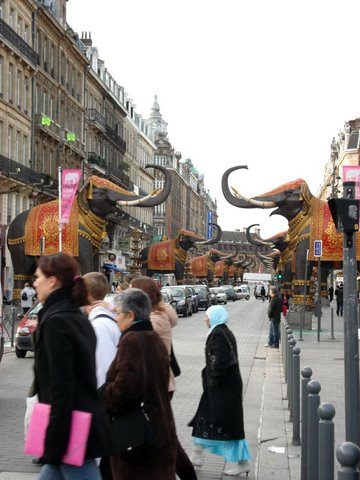
What you would notice the first (they are kind of hard to miss anyway!) are the elephants created by artist Nitin Desai. Nitin started as assistant director to Mira Nair, and has has since created superb decors for Bollyood. There are a total of 12 giant elephants eight meters tall gracing the each side of the main street from the Lille Flanders station to the main center or Grande Place. The elephants are made so beautifully and with such skill, they take your breath away! Big majestic creatures decorated with gold jewels with beautiful tusks(which thankfully aren’t precious enough to be poached away!just yesterday I read yet again of elephants being left to bleed to death after extracting their tusks!)
The station itself is illuminated into an Indian Palace with an illuminated façade of twinkling lights! I could easily imagine myself as a princess lost in the streets of an old Indian town…with the elephants on one side and the illuminated palace on the other!
Sadly since I was there for work I couldn’t find the time to explore the many exhibitions being held across the city. A few I read about were…”Bombay maximum city” an exhibition of photographs, sounds and a variety of images which would help the people to discover the incredible city of Bombay. The exhibition is being organized at the Postal Sorting Office. On the second floor of the building, is the exhibition titled “ Futurotextiles”, or the confrontation between technology and contemporary art. Its on till the 14th January. The Fine Arts Museum in Tourcoing is devoting an exhibition to Le Corbusier in Chandigarh. A French architect who designed one of our most modern cities! Music from across the borders isn’t far behind. Just a week before I landed there, was a performance by Anoushka Shankar at the Lille Opera. The National Orchestra of Lille will also make a point of being part of the event. A meetings between Indian music and symphonic music will be organized, directed by Jean-Claude Casadesus, as well as other concerts centred on scores by Hadyn, Alexander von Zemlinsky or Messiaen. Artists I cannot boast of being familiar with at all but nonetheless am sure for those who were and are there to listen to the concerts, would cherish the experience.
On my side, what I did enjoy was Lille at night! With the towering elephants and the lighted streets, it was wonderful!
It was wonderful to see how little flavor of India was made part of stores. The local patisserie had the elephant on diplay with a load of chocolate on its back! And the regal eagle bejeweled and perched on top a chocolate box!
Colourful flags displaying ”Bombaysers de Lille” flanked the streets everywhere. And motifs of Natraja, the autorickshaw, the elephant and the bull peeped here and there and everywhere on the streets of Lille. The travel agents had big billboards of ”Incredible India”, hoping surely to cash in on the Indian flavour of the season to transport some enthusiasts on another journey to discover the extraordinary country that is India!
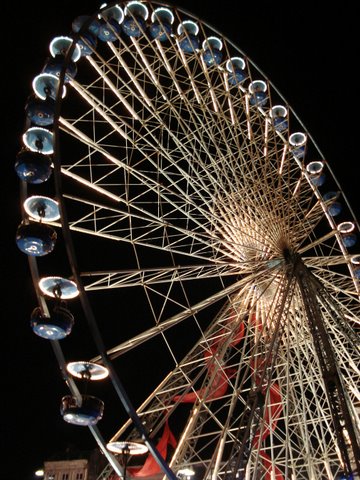
Another wonderful experience I had was riding the huge ferris wheel, installed every year this time for Christmas! Its right in the centre of the Grand place with accompanying installations of reindeers and gingerbread houses all lighted up! My friends and I packed up in our woolens, well prepared to face the cold winds up there! The ride was slow and nice but shaky enough to make all attempts of my pictures from up there kind of blurred! A view from the top is always beautiful and at this time with streets lit up for x’mas and this time the stations lit up as palaces add to the charm!
Being a vegetarian in Lille isn’t easy! And especially when I am accompanied by my collegues from Honk Kong, China, Bangladesh who eat almost every kind of meat among them! But then I manage and manage well and in the end its fun for me and my colleagues who help me out! This time I went along with three other colleagues to a famous Thai restaurant, “Baan Thai”. Inside the restaurant were again very Indian looking wall hangings of old wooden carving with little bells which looked straight from Jaipur! We had a wonderful 5 course meal served to us by a cute chinky waiter. My colleague was kind enough to tell him to make my food spicy. And boy was it! It was yummy but I was eating through my tears! We ended the meal with mint tea which they served to us along with a selection of three different kinds of sugar! Whipped cream, jaggery with sesame seeds and brown sugar and mishri!
Seriously recommended for the food and service for anyone visiting!
The other place we tried and loved was “La Compostelle”. Five minutes from the Grand Place, it was a former coaching inn on the trail of Santiago de Compostela.It houses the sober charm of yesterday with the gastronomy of today. Fine French cuisine is proposed in rooms decorated in a different hue. We chose to sit in the spacious blue room. Choosing it over the red décor room, which was too warm for our liking. We were served in true French style, slow and easy! But the waiting was worth it, with each course better than the other. The most wonderful was the desert of crème brulee I ordered. I got not one but 3 servings in one! Each a different version of the crème brulee . One the original crème brulee, the second slightly with a chocolate flavour and my favorite….crème brulee spiked with vodka! We initially thought the waitress dropped some from my colleagues “Colonel” into my crème brulee! But then what I got was how it was meant to be! :)


Thursday, November 23, 2006

The Ice Hotel - its just so cool!!!

Imagine a hotel built from thousands of tons of snow and ice, and re-built every winter- that is Icehotel in Northern Lapland, Sweden.

The main entrance to the Hotel

ICEHOTEL is situated in the village Jukkasjärvi, 200 kilometres north of the Arctic Circle in Sweden. The heart and backbone is the River Torne flowing freely through the unspoilt wilderness. Covered with a meter thick ice layer winter time the river is the source of all our art, architecture and design. The pure water and the steady movement of the river creates the clearest ice possible.


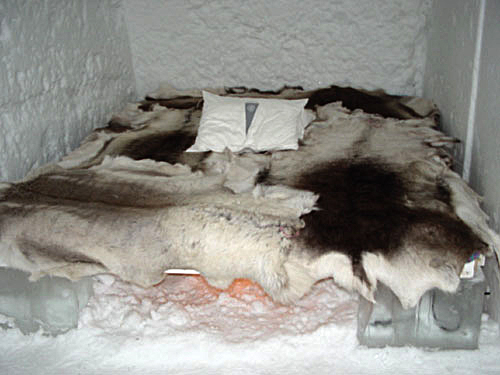
A Reindeer skin bed in the hotel

In Icehotel there are double rooms and suites for overnight guests, a lobby, a pillar hall, film auditorium and of course the famous Absolut Icebar - where folk from all over the world socialize till late.

In the Absolut Ice Bar, drinks are served in glasses made of solid ice

In November, the work starts on building the unique Icehotel and the official opening is in mid December.
By the time the spring sunshine has done its work and the Icehotel has slowly but surely made way for summer and has run back into the River Torne, May has arrived. At the end of April or the beginning of May, the Icehotel closes for the season - all depending on the weather gods however.

High Noon in the Arctic Circle

Staying at ICEHOTEL is a must for the modern adventurer - an experience utterly unlike any other hotel stay. Whilst the temperature outside varies from -10°C down to -40°C inside the Icehotel the bar and bedrooms maintain a "comfortable" -5°C.
The hotel has been built to a different design each year since 1990.
Most people spend one night in the Icehotel itself and a couple of nights in a bungalow. Some bungalows have two twin bunk rooms, others are equipped with a double bed and a large skylight for watching the northern lights (aurora borealis).

I'm planning to visit the hotel in February, inshallah.

Tuesday, November 21, 2006

The Cartier Polo World Cup on Snow - St. Moritz, Switzerland


The Cartier Polo World Cup on Snow will be taking place for the 23rd time next January bringing together professional Polo players and a host of distinguished guests (a host of distinguished guests – oxymoronic or wot?? ) in one of the most breathtaking Alpine settings of them all. Since 1985, when the idea to play polo on the frozen St. Moritz Lake celebrated its world premiere, the Cartier Polo World Cup on Snow has become an indispensible event on the Engadine calendar. At one time considered an extravagant curiosity, this polo tournament has come to accentuate the exquisite image of St. Moritz, and proven itself ideally suited to the chic elegance and high class ambiance to be found in the local legendary "champagne climate". The organizers have certainly succeeded once again to secure exciting participants for this mega event, Cartier Polo World Cup on Snow. The teams from classic polo nations such as Argentina and England promise a spectacular match in the midst of an idyllic, snowcovered alpine setting - certainly the "Top of the World"...

Welcome to the most exciting and unique Cartier Polo World Cup on Snow, which just spells glamour and fun on the frozen Lake of St. Moritz, where the sun never ceases to shine.

The first Polo field in St Moritz was laid out back in 1899, when members of an English Cavalry unit played the game as a part of their military training as well as a way of passing the time. This made St Moritz one of the cradles of the game in Continental Europe. In 1985, Polo celebrated its world premiere on snow and the cornerstone for a new highlight in the St Moritz events calendar was laid. The tournament fits in perfectly with the town’s tourist-related marketing concept. Since then, a number of wintertime tournaments have been established but St Moritz remains the only one played on a frozen lake.


Be there as the wiry, nimble polo ponies fly over the snow. Watch as the world's top polo players from Argentina, Chile, the UK, Australia and other countries give of their best. For the four days of the tournament, there are two top-quality matches daily, culminating in the grand finale on Sunday. These high-level encounters require the highest concentration, strength, finesse, courage and endurance – both from the ponies and their riders. The special conditions on snow, and the unaccustomed altitude of 1800 metres, place exceptional demands on man and animal alike.And as you would expect in the exhilarating surroundings of St Moritz, the world of Polo dovetails perfectly with the cosmopolitan atmosphere that prevails there throughout the winter season.
People meet up for a glass of champagne and elegant dining in the VIP marquee, to go shopping in town, and in the evening to attned one of the countless gala events and parties. When night falls and the lights are lit, guests celebrate the joy of catching up with old- and making new- acquaintances in the town’s superb hotels and restaurants. Whether it’s a club evening in the Chesa Veglia (the town’s oldest house), a glittering gala evening at Badrutt’s Palace Hotel, or a cosy dinner with a small, select of friends, the experience offered by St Moritz while the tournament is on is second to none.

The 23rd Cartier Polo World Cup on Snow will be held in St. Moritz from 25th to 28th January, 2007. We’ll be there to cover the event and will be posting here, live.


STYLISH ST MORITZ - TRIVIA
St Moritz is nearly 1800 metres up Switzerland's Engadine Valley attracts over 320,000 visitors a year. The place was fairly quiet until the English arrived in 1864 introducing the bob sleigh and cricket on ice. St Moritz is said to be the most famous ski resort in the world, yet half of its visitors don't even ski.

Badrutt's Palace is the most exclusive hotel in St Moritz, which boasts Charlie Chaplin, Sylvester Stallone and Claudia Schiffer amongst its clientele. The hotel is also only 10 minutes from the piste. You can take a helicopter ride from St Moritz-Bad to the top of Forkla Grischa, which takes just 4 minutes. Each trip costs approximately US$ 100 and operates on a request-only basis, bookable through your hotel.
St Moritz also offers alternatives to skiing, such as paragliding at around US$ 200 and runs from the Corvillia ski station to the frozen lake adjoining the town. Torchlight skiing is also available on request from the ski school at US$80 per person.
St. Moritz doesn't have the wild après-ski that you might find in St. Anton or Val d'Isère. What it does have are 50 restaurants, 20 bars and the odd night club to choose from. A table at the Kings Club, in the basement of the Palace costs over US$ 400. Cocktails here are $ 30.


NY TIMES RECCOMMENDS THE FOLLOWING IN ST. MORITZ

Winter Wonders

1. Stay at the Kulm Hotel (+41-81-836-8000; doubles from about $410) and spend the afternoon at the skating rink.
2. Ski Corviglia and stop for toast Madagascar (steak on bread) at Restaurant Trutz (by the Suvretta chairlift; +41-81-833-7030; entrees $6 to $22).
3. At Dolce Vita, dig into the excellent penne all’arrabbiata, made with speck and sirloin (via Maistra 10; +41-81-833-1749; entrees $10 to $35).
4. Walk to Pontresina and have tiramisù at Cafe Puntschella (via Mulin; +41-81-838-8030).
5. Have a long, luxurious Italian dinner at the cozy Restaurant Chasellas (via Suvretta 22; +41-81-833-3854; entrees $8 to $18).
6. Go night skiing (until 2 a.m.) on Fridays at Piz Corvatsch (+41-81-838-7373).
7. Eat sennenrösti — a concoction of potatoes, bacon, onions, leeks and cheese — at Hotel Hauser (+41-81-837-5050; entrees $6 to $22).
8. Catch a movie at the old-fashioned Scala Cinema (via Maistra 29; +41-81-833-3155).
9. Shake your booty on the dance floor of King’s Club (via Serlas 27; +41-81-837-1000).
10. Reserve a place in the wooden dining car of the Rhätische Bahn for the journey back to Chur (where you change for Zurich).

Summer Seductions

1. Stay at Badrutt’s Palace Hotel (+41-81-837-1000; doubles from about $355) and park yourself by the pool.
2. Run around the St. Moritz lake with the athletes who train here. Allow 25 minutes.
3. Troll the Heilsarmee (Salvation Army) in Celerina (Innpark Haus C; +41-81-833-9378) for great Swiss and Italian Modernist finds.
4. Trek the (well-marked) mountain trail that leads to the pristine village of Soglio.
5. Take a quick dip in the Lake of Staz or, if you don’t mind a hike, in Lake Nair.
6. Rent a bike from Boom Sport (via Tegiatscha 5; +41-81-832-2222) and tour the network of well-groomed trails that ring the town.
7. Check out the exhibition of vintage tourism posters in the sparkling new parking garage between the train station and Badrutt’s Palace.
8. Have a cup of coffee at Hanselmann, in the town square (via Maistra 8; +41-81-833-3864).
9. Dine on pizzoccheri, buckweat pasta cooked with potatoes and greens, at Restaurant zum Weissen Kreuz in Samedan (+41-81-852-5353; entrees $10 to $38), just outside town.
10. Check into the Klinik Gut (via Arona 34; +41-81-836-3434) and have your aching back fixed.

Wednesday, November 15, 2006

Mumbai Weekend Getaway - Karjat


88 kms from Mumbai, Karjat is where the coastal plains of the Konkan end and the Bhor Ghat begins. In the monsoons and just after, the area is a luxuriant green. Karjat has a number of health resorts, farmhouses and is a base for some easy treks in the area.

Sadia, who has already won a few fans here with her Sunrise over the Himalayas video, writes about her trip. You can also read about her impressions and expressions on life here. She also creates poetry with her pictures - here!

Over to Sadia:


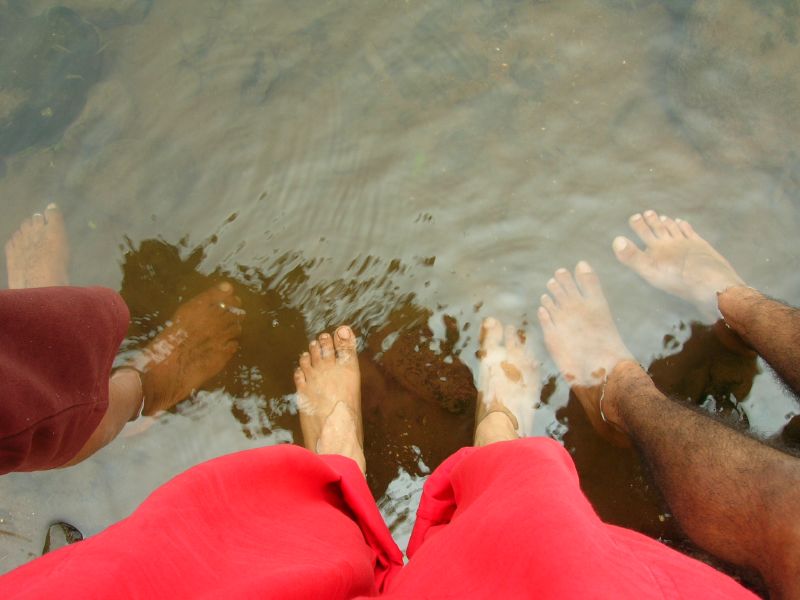
A warm dry afternoon, a browning green landscape, the trickle of a calmly flowing river, colourful, drying clothes, bathing buffaloes, thirsty goats, wet feet and a hot, mossy, slippery contentment.
This was Kondavane village, near Karjat on the mid October afternoon.
This is about the trip taken the weekend before last with a bunch of friends to a friend’s farmhouse near Karjat. On the way we pottered about some villages around the locality.
A wanted, needed, desired, appreciated and in retrospect, loved, break from the coffee pots of bubbling urgencies into a place where time like lukewarm aromatic tea stands still and waits to be sipped and enjoyed.

The evening of course involved a lot of rest, even more photography (where I was specifically told to get a life and take pictures of humans instead of frogs and insects), an awesome barbecue of chicken, peppers and paneer, with women doing all the cutting and marinating and men doing all the coal heating and cooking. This was followed by, two awesome games of pictionary and dumb charades where everyone fought, made up, accused, cheated and freaked out and finally tired as children surrendered to a blissful, unpeturbed sleep.

It was fun. A raw, juvenile, childlike state of merriment and delight.